Always good to know
There is a dramatic increase in ancillary revenue for the airline industry, which highlights the financial scale of this global trend….

The Lisbon Dilemma: A Traveler’s Tale of Treasures, Tensions, and a €140 Lesson

The Lisbon Escape—A Tale of Two Travelers and Their Treasures
It was the kind of escape Ben and Maya had long dreamed of. Tired of the relentless hum of their city, they sought refuge in Lisbon, a city known for its sun-drenched hills, vibrant street art, and a past rich with seafaring adventures. The city itself felt alive, a labyrinth of narrow cobblestone streets and stunning panoramic vistas, easily navigated by the iconic yellow Tram 28. Their goal was not just to relax but to return with a genuine piece of Portugal, something that would anchor their memories far better than a generic keychain or T-shirt.
Their journey into authentic shopping began in Lisbon’s historic districts. Instead of gravitating toward the polished tourist shops, they sought out places that felt rooted in tradition. This desire for authenticity led them to a quiet ceramics workshop, where they marveled at plates and bowls glazed with „intentional imperfection“ and „uncontrolled“ color gradients, reflecting a history of craft passed down through generations. Maya, an avid home cook, was particularly enchanted by a plate adorned with a whimsical cabbage leaf design, a hallmark of the renowned Bordallo Pinheiro pieces. Ben, captivated by the city’s architectural beauty, found himself drawn to the

Sightseeing and a shopping pilgrimage
azulejo tiles that adorned everything from church walls to metro stations. At a historic shop like Fábrica Sant’Anna, which has been crafting hand-painted tiles since 1741, he purchased a few antique pieces, each telling a silent story of the city’s past.
The true heart of their shopping pilgrimage, however, was the Feira da Ladra flea market. Perched on a steep hill in the Alfama neighborhood, the market was a sensory overload of sights, sounds, and history. Rows of sellers laid their wares on blankets, creating an eclectic mix of everything from vintage vinyl records and old books to hand-carved handicrafts and antique objects. The atmosphere was vibrant and full of local flavor, inviting the couple to engage in the time-honored tradition of haggling with vendors. It was here that Maya found a stunning, hand-painted ceramic bowl, its rich colors and detailed patterns a testament to centuries of local artistry. Ben, meanwhile, discovered a small, intricately designed metal bottle opener that felt solid and weighty in his hand. They also picked up some lightweight cork products and artisanal soaps, feeling they had struck a balance between practicality and preciousness.

Fragile items as carry-on-luggage
Their selection of souvenirs was not merely a collection of items but a curated reflection of their travel experience. By choosing authentic, handcrafted treasures—especially the ceramics and heavy tiles—they inadvertently created a core conflict for their departure.
The fragility of these objects meant they could not be simply tossed into a checked bag, where they risked being shattered. This necessitated packing them in their carry-on luggage, a seemingly logical choice that would ultimately pit their cherished finds against the unforgiving regulations of modern air travel. The weight and delicacy of their acquisitions transformed from beautiful mementos into a source of impending drama.
The verdict
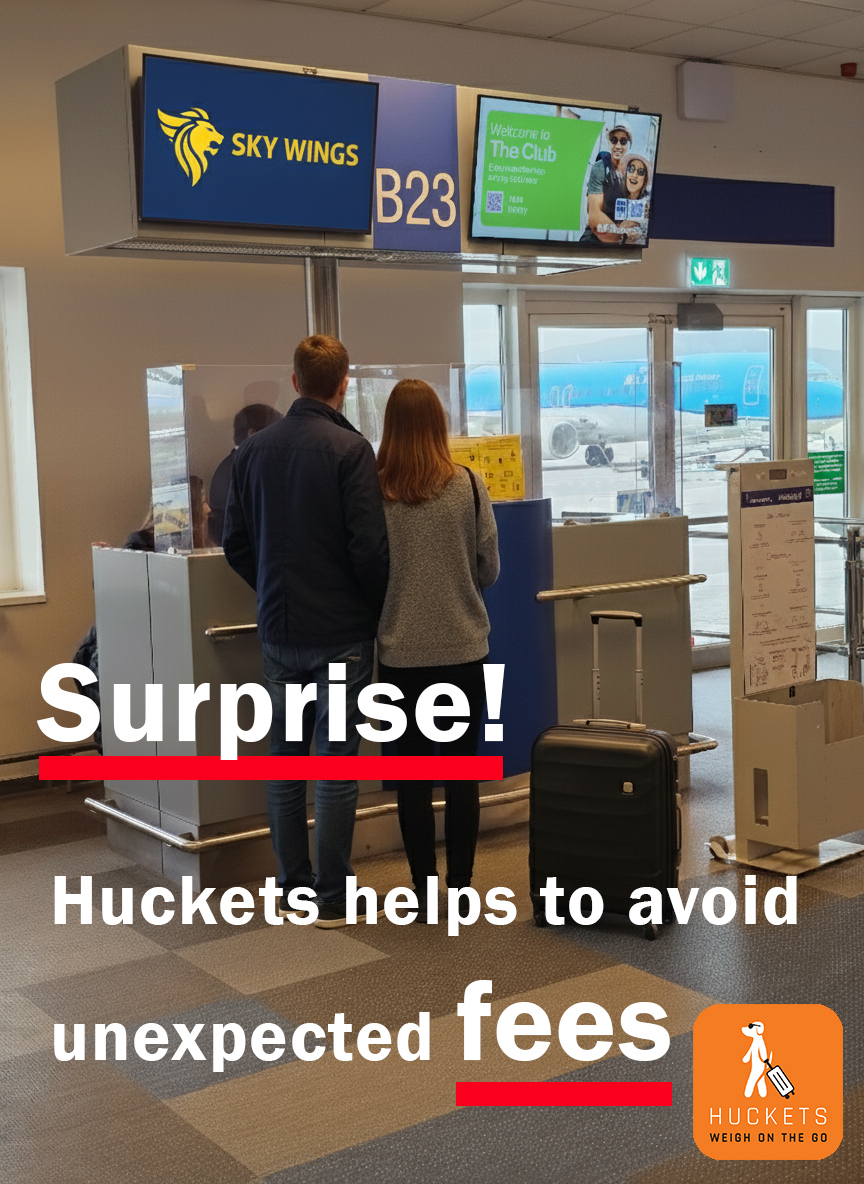
The verdict was swift and unforgiving. Ben’s bag, burdened by the heavy souvenirs, clocked in at 15kg—a full 5kg over the 10kg limit. Maya’s, though lighter, was still 3kg over at 13kg. The attendant, with the impassive efficiency of a machine, delivered the news: each oversized bag would need to be checked into the hold, and for this, a penalty fee of €69.99 per bag would be charged. The total for their oversight came to an eye-watering €139.98, all for two small carry-on bags.
The penalty was a cruel twist of the knife, a punitive measure for a simple miscalculation. Had they been prepared, they could have added a 10kg checked bag to their booking online for as little as €11.99 to €29.99, or even purchased a „Priority & 2 Cabin Bags“ fare for €6 to €36. Instead, they were facing a gate fee that was not only significantly higher than pre-booking, but was designed to capitalize on the exact moment of their vulnerability.
To illustrate the sharp contrast in cost, consider the following breakdown of fees for a single traveler on a fictional airline like „Air-Savvy,“ based on the revenue models of real low-cost carriers:
The table starkly demonstrates the calculated nature of the gate-side fee. It is a premium designed to extract maximum value from a passenger in a position of minimal leverage. The emotional and financial toll of this „gotcha“ moment overshadowed the joy of their trip, leaving a bitter taste in their mouths as they handed over their credit card.
The Moment of Reckoning—A Check-In Drama
The morning of their departure was clouded by a low-lying anxiety. As Ben and Maya tried to close their respective carry-on bags, they noticed the zippers straining. The souvenirs from their excursion, particularly the dense ceramic plate and the handful of historic azulejo tiles, had added a surprising amount of bulk and heft. They dismissed their concerns with a shared shrug, assuming a few extra kilograms would not be an issue. After all, they were just traveling with cabin bags. This small act of denial set the stage for the frustration to come, a scenario made all too common by the shifting landscape of airline policy.
At Lisbon’s Humberto Delgado Airport, the true drama began not at the security checkpoint, but at the boarding gate. As they approached the gate, a stern-faced attendant from „Air-Savvy,“ a low-cost carrier whose policies were built on the model of airlines like Ryanair, flagged them. Their large carry-on bags, she explained, would need to be measured and weighed. Their confidence quickly evaporated as they watched their bags, crammed with their precious finds, disappear into the metal cage of the bag sizer.
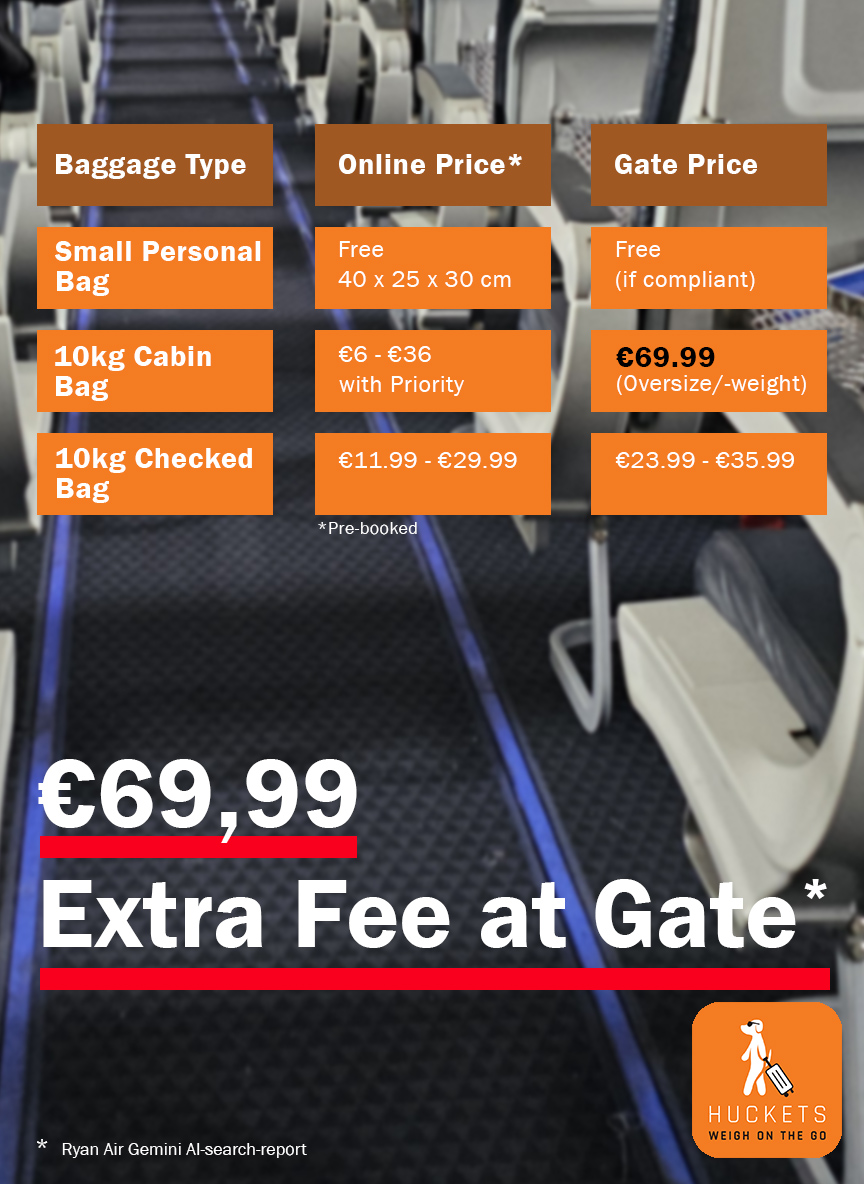
DISCLAIMER: Fees accordingly to a report provided by Gemini AI. Retrieved at 06th of Spetember 2025. Subject of change without notice by the airline.
The Broader Context—A Traveler’s Dilemma in a Post-Pandemic World
It is the airlines strategy
Ben and Maya’s experience was not an isolated misfortune but a symptom of a sweeping transformation within the global airline industry. Their frustration at being „nickel-and-dimed“ at the gate is a feeling shared by millions of travelers as airlines, particularly low-cost carriers, have fundamentally restructured their business models. The travel disruption caused by the pandemic, while devastating at the time, accelerated a trend that has now become a central pillar of airline profitability: the aggressive pursuit of ancillary revenue.
Ancillary revenue refers to all income generated from sources other than the base airfare, encompassing a broad range of services from baggage fees and seat selection to in-flight meals and loyalty program monetization. The growth of this revenue stream has been nothing short of explosive. According to recent data, global ancillary revenue is projected to reach an astounding $148.4 billion in 2024, marking a remarkable 26% increase from the prior year. This figure is also approximately $39 billion higher than pre-pandemic levels in 2019, demonstrating that the post-COVID-19 surge is not merely a recovery but a new, more aggressive phase of market strategy.
Unbundling every service
Low-cost carriers, in particular, have mastered this approach. By unbundling virtually every service and charging for it as an „extra,“ they are able to advertise deceptively low base fares that entice customers. The penalty for an oversized carry-on bag at the gate is a prime example of this strategy in action. The fee is set at a punitive level not just to cover the cost of handling the bag, but to serve as a powerful behavioral deterrent and, in cases of non-compliance, a highly profitable revenue stream. The psychological pressure at the gate, where a traveler is anxious to board their flight and cannot easily find an alternative solution, allows the airline to charge a fee that is dramatically higher than the cost of a pre-booked service.
The consumer’s frustration has not gone unnoticed. In an effort to curb these „surprise junk fees,“ the U.S. government has taken action, requiring airlines and ticket agents to disclose all fees for checked bags, carry-on bags, and flight changes clearly and conspicuously upfront, before the ticket is purchased. This intervention confirms that the practice of obscuring these costs is a recognized problem, one that the modern traveler must now navigate.
The scale app
The dramatic increase in ancillary revenue can be visualized in the following table, which highlights the financial scale of this global trend:
| Year | Global Ancillary Revenue (Projected) |
| 2024 | $148.4 billion |
| 2023 | $117.9 billion |
| 2019 (Pre-Pandemic) | ~$109.5 billion |
This data confirms that the „greed“ of airlines, as perceived by travelers, is not an emotional overstatement but a verifiable business strategy. It has become an essential component of their profitability, now accounting for 14.9% of total global airline revenue.
The passenger’s experience, from Ben and Maya’s airport ordeal to the thousands of others paying similar fees, is a direct consequence of this industry-wide pivot.
The Strategic Solution—Planning for a Smoother Journey
Be better prepared
Avoiding surprises, better knwo the exact weight of your luggage
The bitter lesson learned at the Lisbon airport was not one of misplaced trust, but of unpreparedness in a new travel reality. Ben and Maya realized that their simple oversight had been a costly one. They had purchased their travel treasures with a sense of carefree spontaneity, not fully understanding the financial trap that lay in wait at the departure gate. They had assumed a level of flexibility and forgiveness that no longer existed in the world of low-cost air travel.
Their story, however, offers a clear path forward for the savvy traveler. In an era where airlines profit from an unbundled, a-la-carte model, the solution is to reclaim control. For travelers like Ben and Maya, the solution lay in a simple, yet powerful, innovation: luggage with a built-in weight scale.
Your suitcase can tell you it´s own weight
The integrated weight scale is an essential tool navigating the modern travel landscape
A suitcase that can tell you its own weight is not a luxury; it is an essential tool for navigating the modern travel landscape. It eliminates the guessing game, the frantic last-minute repacking, and the fear of the „gotcha“ moment at the gate. With a quick glance, travelers can know if their bag complies with the strict 10kg limit and adjust accordingly. This simple technology removes the psychological stress and financial risk that Ben and Maya faced, empowering them to travel with confidence and peace of mind.
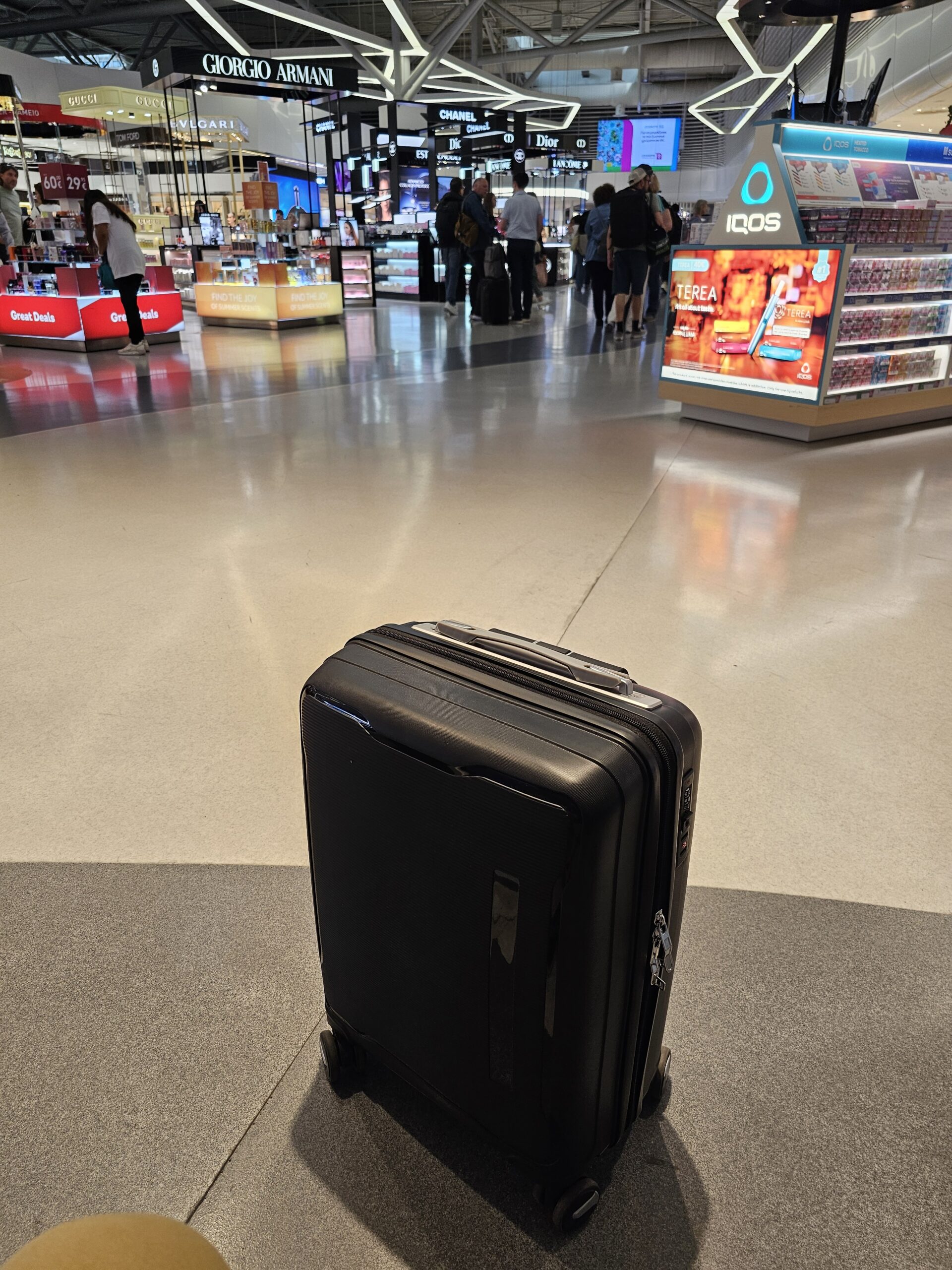
Prebook to save eventually hundreds of Euros or Dollars
For every traveler, a new pre-flight checklist is now in order. It is no longer enough to simply pack your bags and head to the airport. The modern traveler must:
- Know the Fine Print: Each airline has its own specific and often complex baggage policy. Always verify the maximum carry-on dimensions and weight allowances for your specific ticket class.
- Pre-book, Always: A gate fee is a penalty, not a service. Pre-booking checked luggage or a priority boarding pass is almost always cheaper than paying at the gate.
- Be Proactive: Beyond a smart suitcase, simple habits can help. Wear your heaviest items, use compression bags to maximize space, and always measure your bag when it is fully packed.
The „greed of airlines“ that has surged past the pandemic is not a myth; it is a meticulously crafted business model designed to maximize ancillary revenue. By treating travel not as a simple ticket purchase but as a series of paid services, airlines have shifted the burden of preparation onto the passenger. As Ben and Maya’s story illustrates, the era of travel spontaneity is over. The new era demands a strategic, informed approach, and for many, that journey begins with a suitcase that can tell you its own weight.
My Contact Information
(+49) 163 197 88 88
Vitality Services LLC- Huckets
801 Pennsylvania Ave. NW,
Unit 1112
Washington DC 20004 USA
Legal Info
- Privacy
- Cookie Policy
- Credits